
Why We're Building a New File Format
Why .ndjm exists and why legacy formats don't cut it.
March 15, 2026 · 8 min read
Office documents haven't fundamentally changed since the 1990s. .docx, .xlsx, and .pptx are ZIP archives of XML designed for desktop software and local file systems. They were built for a world where documents lived on hard drives, got emailed as attachments, and were edited by one person at a time. That world no longer exists. Nodejam is building .ndjm, a purpose-built format designed for cloud databases, agents, and real-time workflows.
Legacy Formats Were Not Built for This
Modifying a Word document means unpacking a compressed archive, changing the content, and repackaging everything. A simple text replacement becomes a multi-step process with dozens of failure modes. Spreadsheets store entire grids of empty cells even when you only have ten rows of data. Presentations embed images directly into the file, bloating document sizes.
These formats were designed for desktops. Today, documents get processed by software hundreds of times per session. The gap between what legacy formats were built for and what modern workflows demand isn't a minor inconvenience. It's a fundamental limit on what's possible.
What .ndjm Is
The .ndjm format is a proprietary document representation designed for modern infrastructure. Three content types are unified under one format. Text documents, spreadsheets, and slides, each with the depth you'd expect from a dedicated editor.
Documents stay lightweight by design. The format is built for efficiency and native AI integration.
Designed for Agents
The format works without any agent involvement. You can create, edit, and manage documents entirely on your own. But most AI tools for documents are plugins bolted onto legacy formats, inheriting every limitation underneath. Nodejam took a different approach. Build the format first, then build the agent system natively on top of it.
Nodejam's agent reads and writes .ndjm directly. No conversion, no unpacking, no extra steps. When it needs to insert a row into a spreadsheet, it does exactly that. When it needs to reformat a paragraph, it targets only the content that needs to change. The format is compact by design. The agent works with only the data that matters.
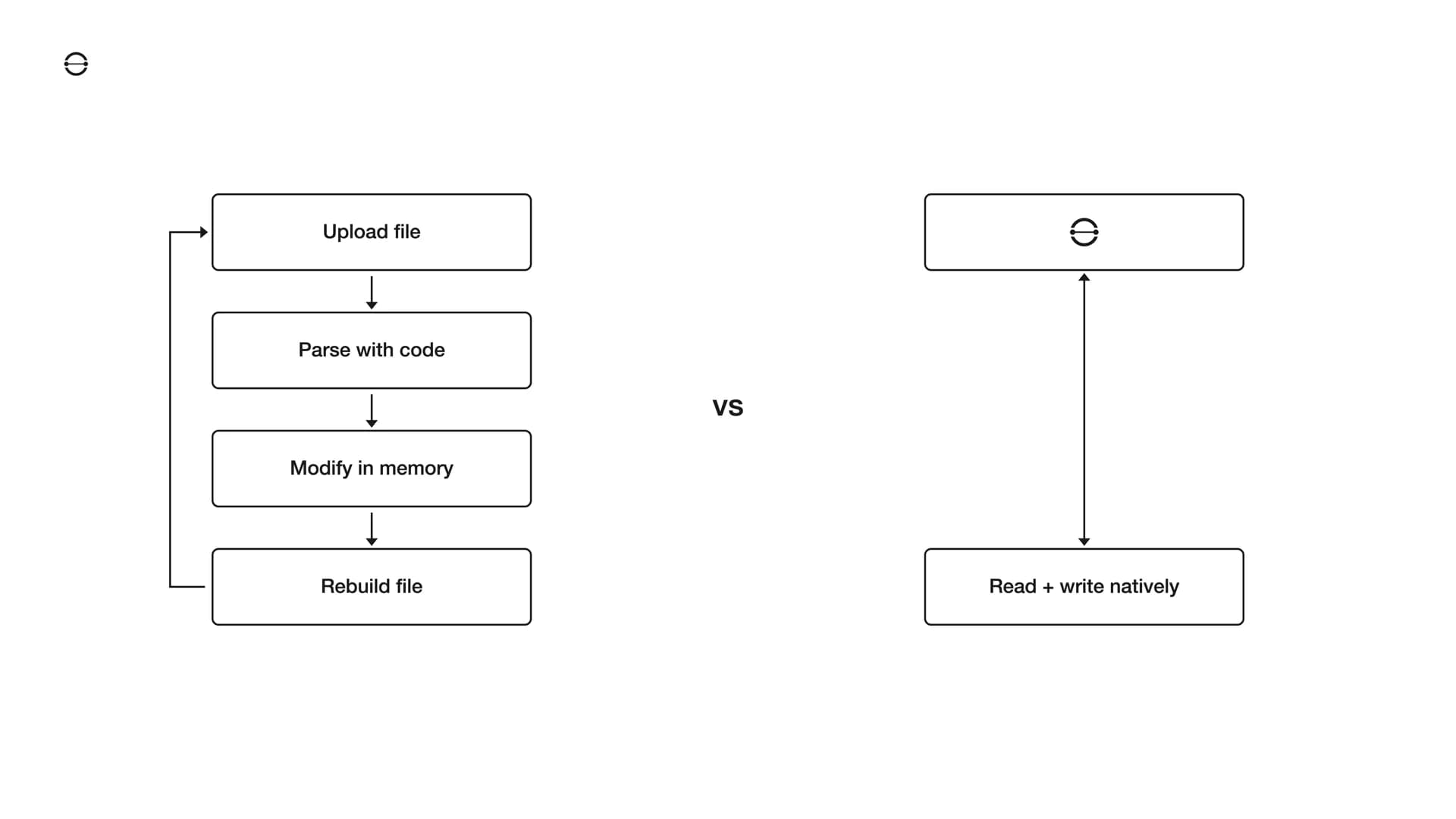
The agent can make dozens of edits in a single session. No save step, no export step. The document it modifies is the document you see. What the agent works with is the content itself, not layers of packaging around it.
A Project, Not a File
In legacy suites, Word, Excel, and PowerPoint are separate applications with separate formats. They don't share context, don't share structure, and can't reference each other natively. An agent working across them is switching between entirely different systems. In .ndjm, there's no app boundary.
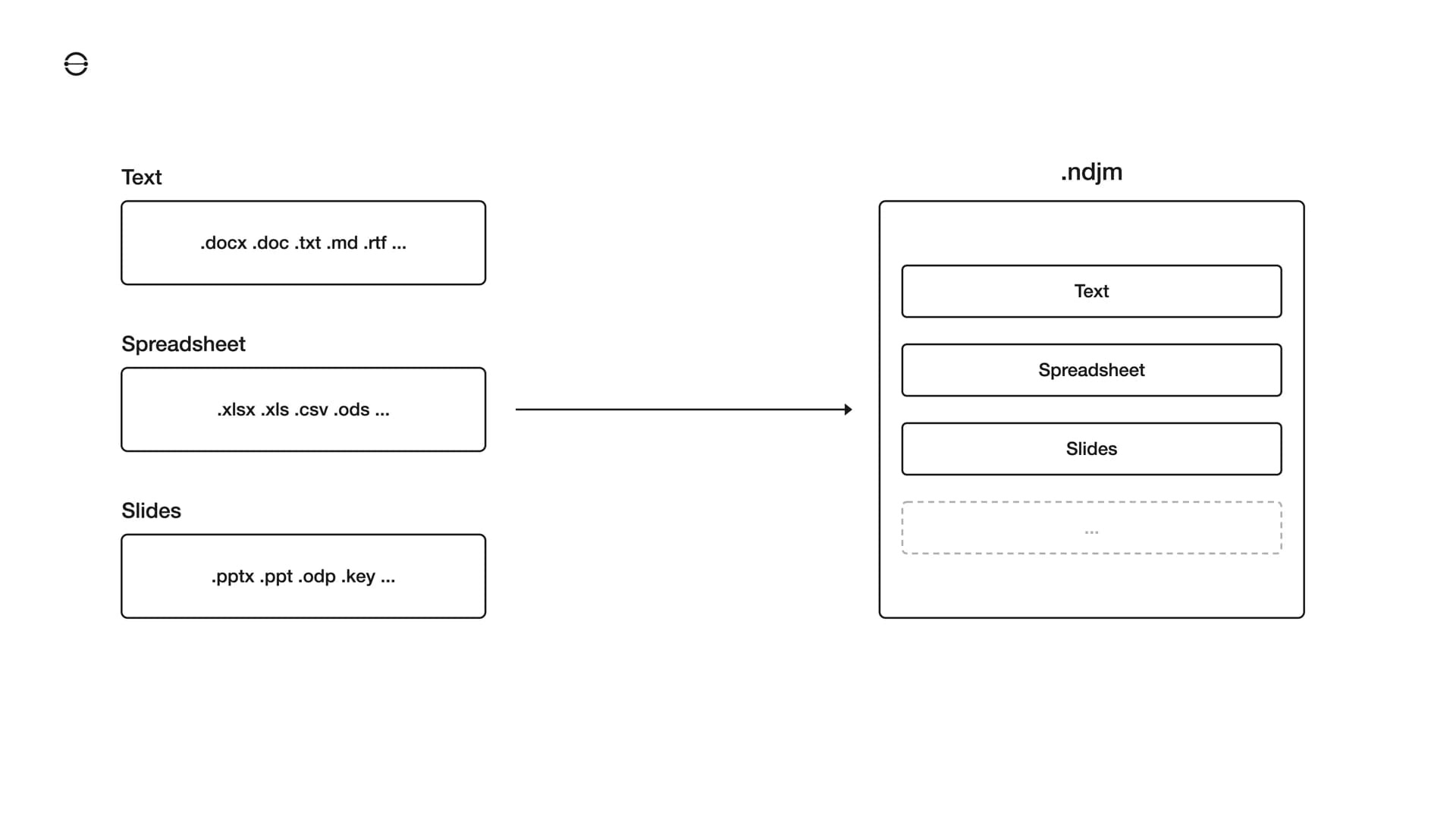
The .ndjm format isn't a single document. It's a collection of files within a project. Text documents, spreadsheets, and slides coexist in one workspace. This reflects how real work happens. A financial model lives next to the memo that explains it, which lives next to the presentation that summarizes it. The agent operates across all of them, combining and cross-referencing content that legacy formats keep siloed.
Current Challenges
Building a new format doesn't mean abandoning the old ones. The world still runs on DOCX, XLSX, and PPTX, and we don't expect that to change overnight. Importing and exporting legacy formats has to work well. Anything less would make .ndjm an island. The challenge is that the same document can look completely different depending on which version of which app created it. Import fidelity is a solvable problem. It just takes time. The pipeline works today, and accuracy improves with every iteration.
Building a file format from scratch also means rebuilding every feature that legacy formats have had decades to accumulate. We're at roughly 80-90% parity with what legacy formats can carry today. The remaining gaps aren't architectural limitations. They're engineering iterations, the same kind of work that closed the first 80%. The goal isn't just to match what exists. It's to surpass it, and to rethink the things that never needed to be that complicated in the first place.
What Comes Next
Text, spreadsheets, and slides are just the beginning. The .ndjm format is designed to grow. New content types, deeper integrations, and capabilities that legacy suites were never architected to support. When you're not constrained by formats built for a different era, the ceiling disappears.
We're not building a better version of what already exists. We're building what comes after it. The file format is the foundation. Everything else builds on top of it.