
One workspace for procurement, design, and renovation
Elite Hotels runs 42 hotels across 29 locations in Sweden. Their construction, project management, and interior design teams used Nodejam to replace scattered office tools with a single AI-powered workspace, producing 41 files and 28 AI sessions across a December to January evaluation window.
January 2026 · 6 min read
The challenge
Elite Hotels is one of Sweden's largest privately owned hotel groups, operating 42 hotels across 29 locations. The group is known for restoring and operating distinctive heritage buildings while maintaining consistent quality standards across a portfolio that includes gastropubs, conference venues, and city-center properties. Their construction, interior design, and project management teams run a continuous pipeline of property upgrades, from bathroom renovations to full-floor refurbishments, coordinating across procurement, design specification, and stakeholder reporting.
Each discipline brought its own tools and document conventions. Article lists arrived as email attachments. Supplier offers were scattered across inboxes. Imported PDFs required manual restructuring. Procurement documents lived in Word, project timelines in Excel, and design presentations in PowerPoint. When it came time to present to leadership or coordinate across departments, information had to be manually gathered, reformatted, and reconciled across all three applications.
Scattered tools
- Article lists as email attachments
- Supplier offers buried in inboxes
- PDFs requiring manual restructuring
- Separate applications for specs, budgets, and presentations
- Copy-paste between Word, Excel, and PowerPoint for every deliverable
One workspace
- Source documents imported directly into the project
- AI restructures PDFs and Office files on arrival
- Text, spreadsheets, and slides live side by side
- Leadership materials generated from live project data
- All work conducted in native Swedish with no language switching
Use case highlights
From Room Inventory to Leadership Decision
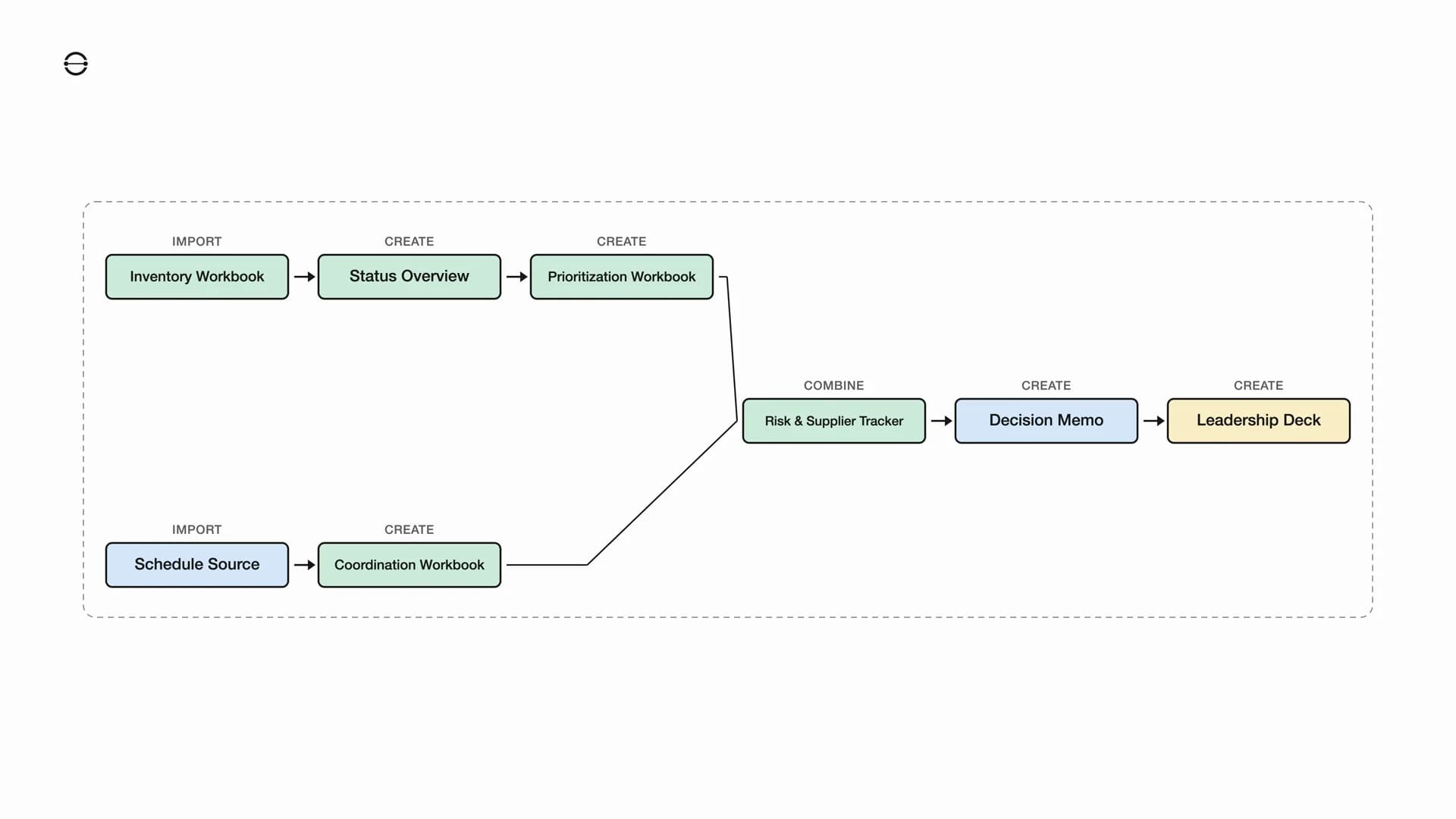
The construction coordinator begins by importing a room-level inventory workbook and a separate schedule source into the same workspace. From the inventory, Nodejam creates a status overview and then a prioritization workbook that ranks which rooms need attention first. From the schedule, it creates a coordination workbook that maps procurement timing block by block. Those two tracks converge when Nodejam combines the prioritization and coordination workbooks into a single risk and supplier tracker. That tracker feeds a decision memo written after one targeted audience clarification, and the memo in turn becomes a leadership deck ready for management review.
With separate tools, the room data would live in one spreadsheet application, the schedule in a document editor, and the leadership presentation in a slide tool. Every handoff between them would mean copying, reformatting, and losing traceability. Here the entire chain stays in one workspace, so the leadership deck at the end is still directly connected to the room-level inventory it started from.
From Hotel Procurement Work to HQ Planning
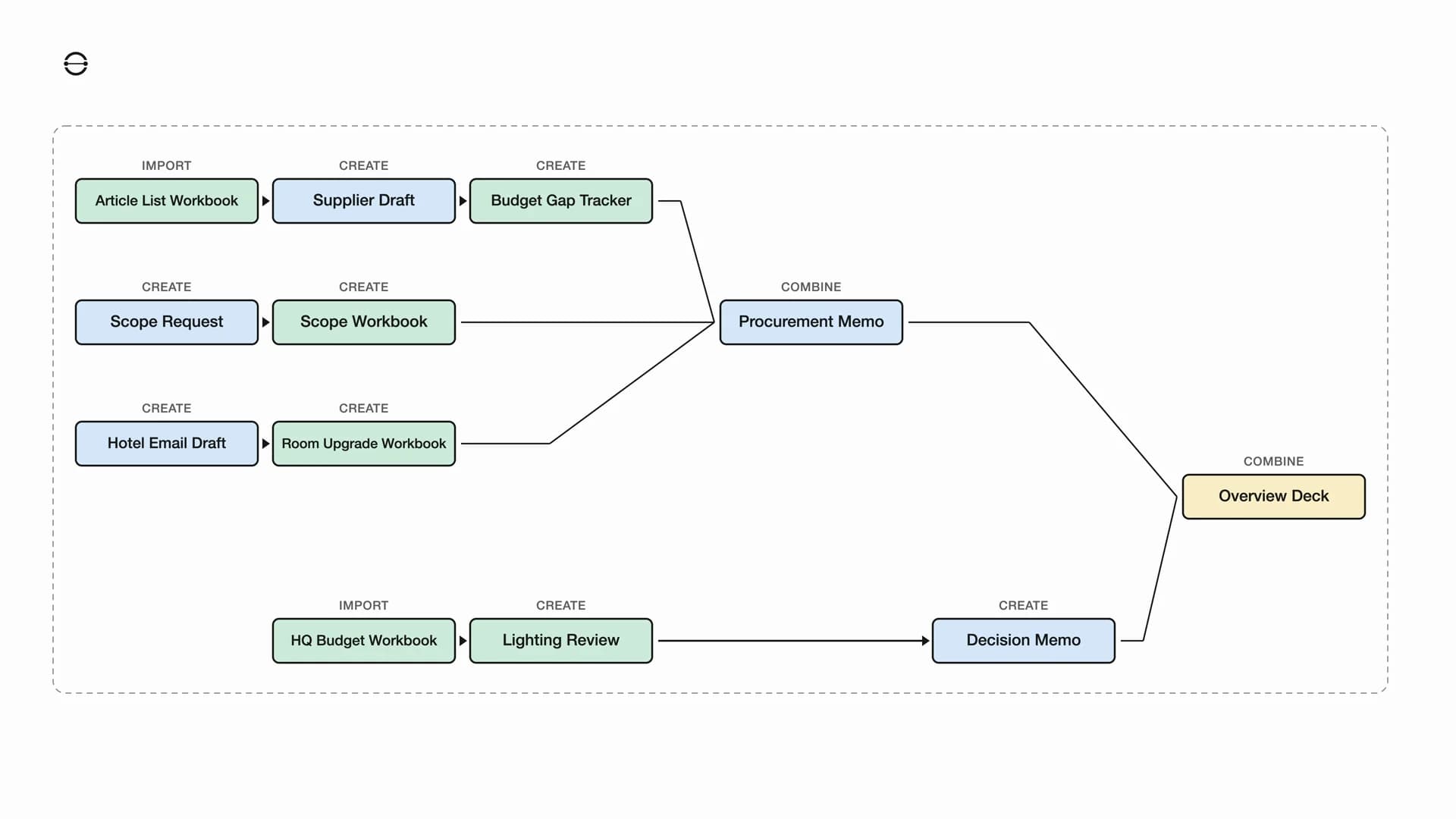
The interior project manager runs four parallel work streams that converge into a single overview deck. In the first, she imports an article list workbook and turns it into a supplier draft followed by a budget gap tracker. In the second, she creates a scope request for a facade revision and refines it into a scope workbook. In the third, she drafts a hotel email about furniture needs and extends it into a room upgrade workbook. Those three streams combine into a procurement memo covering all active hotel projects. Separately, she imports an HQ budget workbook, creates a lighting review from it, and writes a decision memo after one audience clarification. The procurement memo and the decision memo then feed together into a combined overview deck.
In a traditional setup, supplier correspondence would sit in an email tool, article tracking in a spreadsheet application, scope documents in a word processor, and the final overview in a presentation tool. Updating a budget number would mean hunting through four disconnected applications. Here every stream reads from and writes to the same workspace, so the overview deck reflects live project state rather than a manually assembled snapshot.
From Live Design Files to a Digital Sample Board
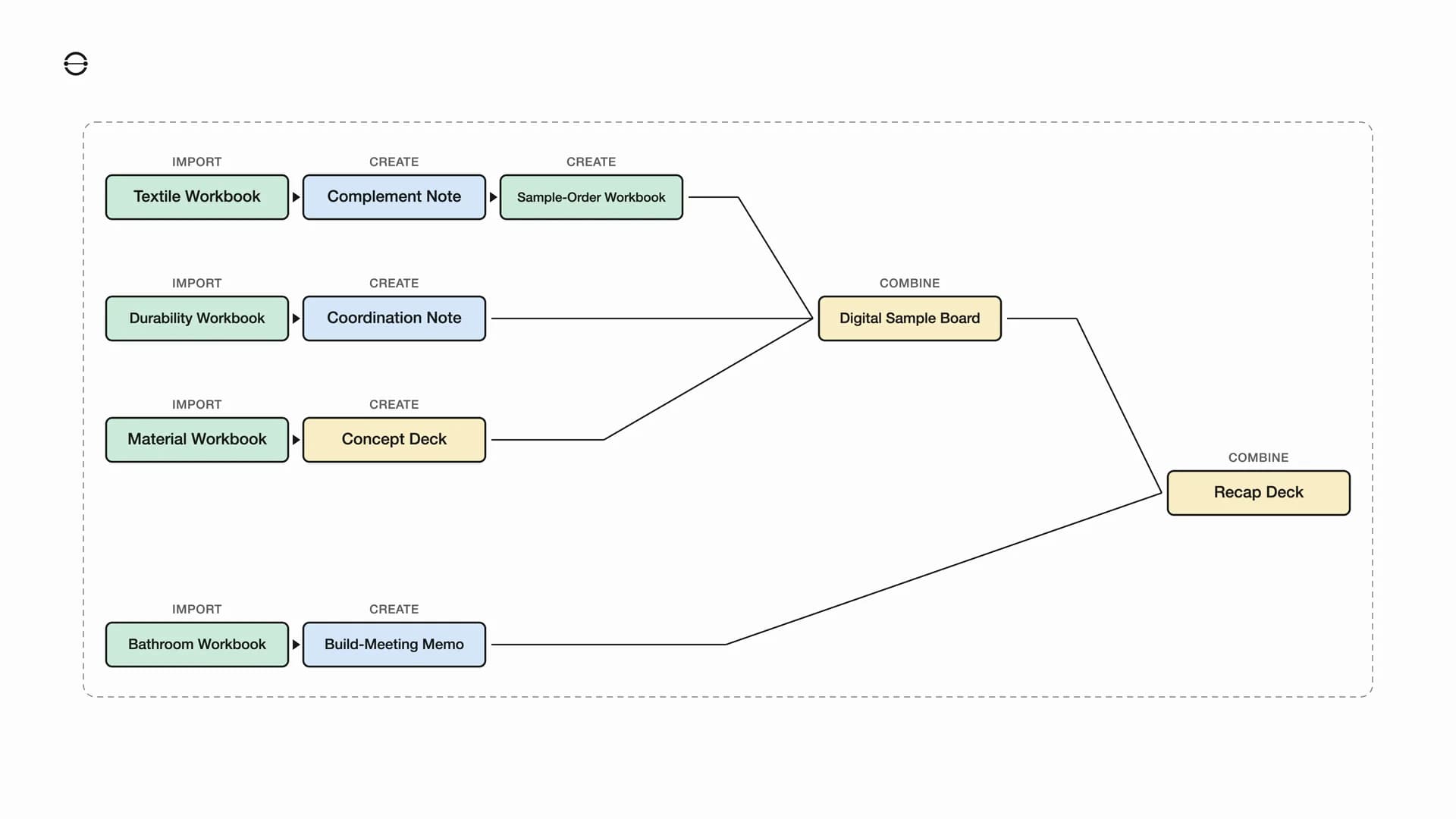
The interior designer imports four source workbooks and builds a connected design corpus from them. The textile workbook becomes a complement note and then a sample-order workbook for day-to-day material tracking. The durability workbook becomes a coordination note flagging what to push forward with the project manager. The material workbook becomes a concept deck that stays internal and non-procurement in tone. Those three streams converge into a combined digital sample board that collects swatches, materials, and selections in one place. Meanwhile, the bathroom workbook becomes a build-meeting memo written after one audience clarification. The sample board and the build-meeting memo then feed together into a combined recap deck covering the full material and bathroom status.
Design review, sample tracking, and construction coordination typically scatter across mood boards, spreadsheet tools, and separate presentation software. When a textile choice changes, it does not automatically update the sample board or the recap deck. Here the designer works in one workspace where the sample board reads from the same live textile, durability, and material files that produced it, so every downstream output stays current without manual re-assembly.
Usage data
41
Total files
16
Text
20
Spreadsheet
5
Slides
Project Files
Over five weeks the team produced 41 files, with 20 spreadsheets, 16 text documents, and 5 slide decks in the mix. Each role landed somewhere different. The construction coordinator spent most of their time in spreadsheets, which fits the procurement and site tracking side of the work. The interior project manager kept a roughly even split between text and spreadsheets, in line with juggling supplier correspondence and budget workbooks. The interior designer was the only one to build multiple slide decks, mostly for material and sample reviews. One workspace covered every file type these three people needed, and no one had to leave it for a separate application.
Session Activity
The pattern follows how the team actually worked through the calendar. The first week opens with a spike as all three people start importing source material and setting up their files. The next two weeks settle into steady operational work. Then usage goes flat for two weeks across the Swedish Christmas and New Year break, where nobody touched the product. Activity picks up again in early January and climbs toward the leadership review on January 9.
Agent Execution Reliability
75
tool calls
Completed on first attempt
Actions that went through cleanly with no retry needed.
Auto-recovered via retry
Brief network or upstream hiccups that recovered on their own without the user noticing.
Clarifications requested
Moments where the AI paused to ask a quick question before writing, because the answer would have changed the output.
Across 75 agent actions over five weeks, 89.3% went through on the first attempt with no retry needed. Of the rest, 6.7% were brief network or upstream hiccups that recovered on their own without the user noticing, and 4.0% were moments where the AI paused to ask a clarifying question before writing, because the choice of audience would have changed the output. Every single session ended with a finished file. The AI stays autonomous on operational work and only checks in when the answer would change what gets produced.
What we learned
Each team member produced real, role-specific work in their first sessions without training or shared templates. All files, content, and AI conversations were conducted entirely in Swedish.
Property coordination work is never one file type. A bathroom inventory becomes a risk assessment becomes a procurement decision becomes a leadership presentation. Nodejam is the workspace where that chain stays connected.
Across 41 files, 28 AI sessions, and 150 messages, three team members showed that text documents, spreadsheets, and slide decks do not need to live in separate applications. Sixteen sessions started from imported source documents like PDFs, Office files, and screenshots. The AI carried context across every file in the project, so each new deliverable built on what came before without manual re-entry.
For a hotel group managing renovations across 42 properties, that kind of workflow continuity matters. The workspace fit how people already worked instead of asking them to learn something new.